
Pentest Chronicles
The Danger of Leaking Cookies in HTTP Response Bodies

Marcin Zięba
March 13, 2026
If the HttpOnly flag (optional) is included in the HTTP response header, the cookie cannot be accessed through client side script (again if the browser supports this flag). As a result, even if a cross-site scripting (XSS) flaw exists, and a user accidentally accesses a link that exploits this flaw, the browser (primarily Internet Explorer) will not reveal the cookie to a third party.
~https://owasp.org/www-community/HttpOnly
In other words, the httpOnly flag secures application’s cookies by preventing a web browser from accessing cookies using JavaScript. In such case attacker who finds a Cross Site Scripting vulnerability will not be able to extract it by accessing document.cookie.
Even with httpOnly flag is in place when even one application’s module is poorly designed, attacker can achieve his/her objective and steal the cookie – if session cookie is reflected in HTTP response body an attacker can use a simple regex to retrieve desired string (cookie value) from response body and steal it like the flag never existed. PROOF OF CONCEPT The session cookie is named sessid and its secured by httpOnly flag.
The listing below presents a default JavaScript injection for a parameter found to be vulnerable to Cross Site Scripting:
 The below screenshot confirms the vulnerability existence:
 During the tests it was found out that one of application’s pages contains a session cookie in HTTP response body:
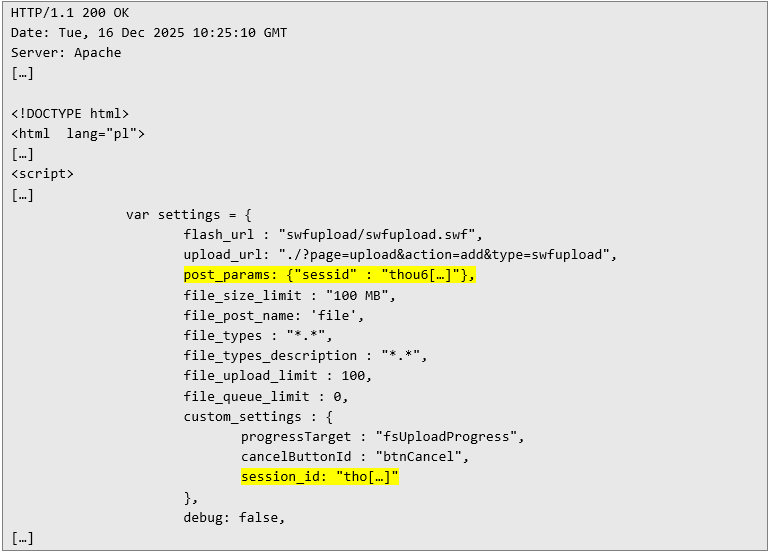 As mentioned before, such behavior can be leveraged to steal a session cookie even if httpOnly flag is in place.
Below there is a JavaScript code which:
1. loads the page where session cookie is disclosed in the HTTP body,
2. extracts the cookie value using the regex,
3. sends extracted line to the attacker-controlled server.
 Below there is a full link which can be directly passed to the victim in order to execute the attack:
 Opening the link in a victim’s browser triggers 3 steps which leads to retrieving the cookie on the attacker-controlled server:
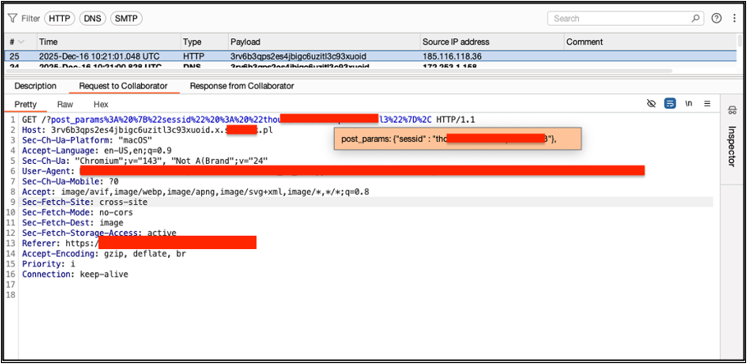 As demonstrated above, even when using the httpOnly flag, a web application can still be vulnerable to cookie stealing if there is a single point of failure. Based on that make sure that application never reveals session cookies in server’s responses.
Next Pentest Chronicles

When Usernames Become Passwords: A Real-World Case Study of Weak Password Practices
Michał WNękowicz
9 June 2023
In today's world, ensuring the security of our accounts is more crucial than ever. Just as keys protect the doors to our homes, passwords serve as the first line of defense for our data and assets. It's easy to assume that technical individuals, such as developers and IT professionals, always use strong, unique passwords to keep ...

SOCMINT – or rather OSINT of social media
Tomasz Turba
October 15 2022
SOCMINT is the process of gathering and analyzing the information collected from various social networks, channels and communication groups in order to track down an object, gather as much partial data as possible, and potentially to understand its operation. All this in order to analyze the collected information and to achieve that goal by making …

PyScript – or rather Python in your browser + what can be done with it?
michał bentkowski
10 september 2022
PyScript – or rather Python in your browser + what can be done with it? A few days ago, the Anaconda project announced the PyScript framework, which allows Python code to be executed directly in the browser. Additionally, it also covers its integration with HTML and JS code. An execution of the Python code in …